Financing for auto shops
Bays earn when they are full and cost when they are not. Most shop financing is about capacity — another lift, another tech, more parts on the shelf.
How the money reads
An underwriter reads six months of statements. This is what yours usually says.
- Deposits are frequent and small: card, fleet accounts, insurance work.
- Fleet and insurance work pays on terms, which puts a gap between the labour and the money.
- Parts are bought per job, so supplier payments track the revenue closely.
Small and frequent on both sides, which makes the account easy to read and the cushion thin. Fleet and insurance work sits on terms behind the daily rhythm and does not show as its own shape.
The thing that slows these files down
If a meaningful share of revenue is fleet or insurance work paying on thirty days, say so. It changes how the deposit pattern is read, for the better.
What it usually pays for
- A hoist, an alignment rack, diagnostic equipment
- Parts inventory so jobs are not waiting on a delivery
- A bay expansion or a second location
What an underwriter asks
The same four things decide every file: revenue and how long you have been making it, the cash cushion, bounced payments, and what you already pay other lenders. Here is what those look like in this trade.
- How much of the work pays on terms?
- Retail customers pay on the day. Fleet and insurance work pays in thirty. A shop with a lot of fleet has a gap between the labour and the money, and saying so makes the deposit pattern read better, not worse.
- Are the bays full?
- Capacity is the constraint in this trade, and the account shows it. Steady frequent deposits at a ceiling is a different file from the same revenue trending up.
- What does parts buying do to the balance?
- Parts go out per job, so supplier payments track revenue closely and the cushion stays thin by design. The average daily balance is read against a month of revenue, and in this trade it is usually the number worth improving first.
- 1Revenue, and how longThe monthly average, and the years behind it
- 2The cash cushionAverage daily balance, against a month of revenue
- 3Bounced paymentsNSF and returned items over ninety days
Totalled against monthly revenue and capped at 20% — the ceiling we pre-qualify to. This is the one that binds: two advances already running leaves less room than none, however good the rest looks.
The split shown is an example, not your file. Yours is read by a person, from your own statements.
Asking for the right amount
A hoist has a price; ask for it. Where the money is for parts inventory, size it against what you currently lose to waiting on a delivery, and say that in the one line.
Across every trade the anchor is the same: roughly a month of revenue, and never more than the statements support. What you already pay other lenders matters as much as what you are asking for, and you need an average of at least $20,000 a month to qualify at all.
When to ask
There is no season to wait for. The useful timing rule here is to apply before the equipment is needed rather than after a bay has already gone quiet without it.
Have these ready as well
On top of the standard file — six months of statements, your incorporation documents, your CRA business number and photo ID.
- Quotes for the equipment — hoist, alignment rack, diagnostic gear
- Your lease, if the work needs the landlord's consent
- Environmental or licensing permits where your province requires them
- Fleet or insurance account agreements, if they are a meaningful share of revenue
What usually fits
In this order, more often than not — though the file decides, not the trade.
Equipment financing
The oven, the van, the line. Financed against the thing itself, so the payment sits against what the thing earns.
$10,000 to $1,000,000
Term loans
A fixed amount, a fixed schedule, and nothing pledged against it. The straightest answer when you know the number and the timeline.
$5,000 to $2,000,000
Revenue-based line of credit
Draw what you need, pay for what you draw, and the limit moves with your revenue. For months that are uneven, not short.
Up to $500,000
Where these files get harder
None of these is an automatic no. They are the things that turn a one-day decision into a conversation, and all of them are better said by you than found by an underwriter.
- A shop where most revenue is one fleet account
- Bounced payments in the last ninety days, which weigh more in a trade with a thin cushion
- Equipment bought on supplier terms already, since that counts as what you pay lenders
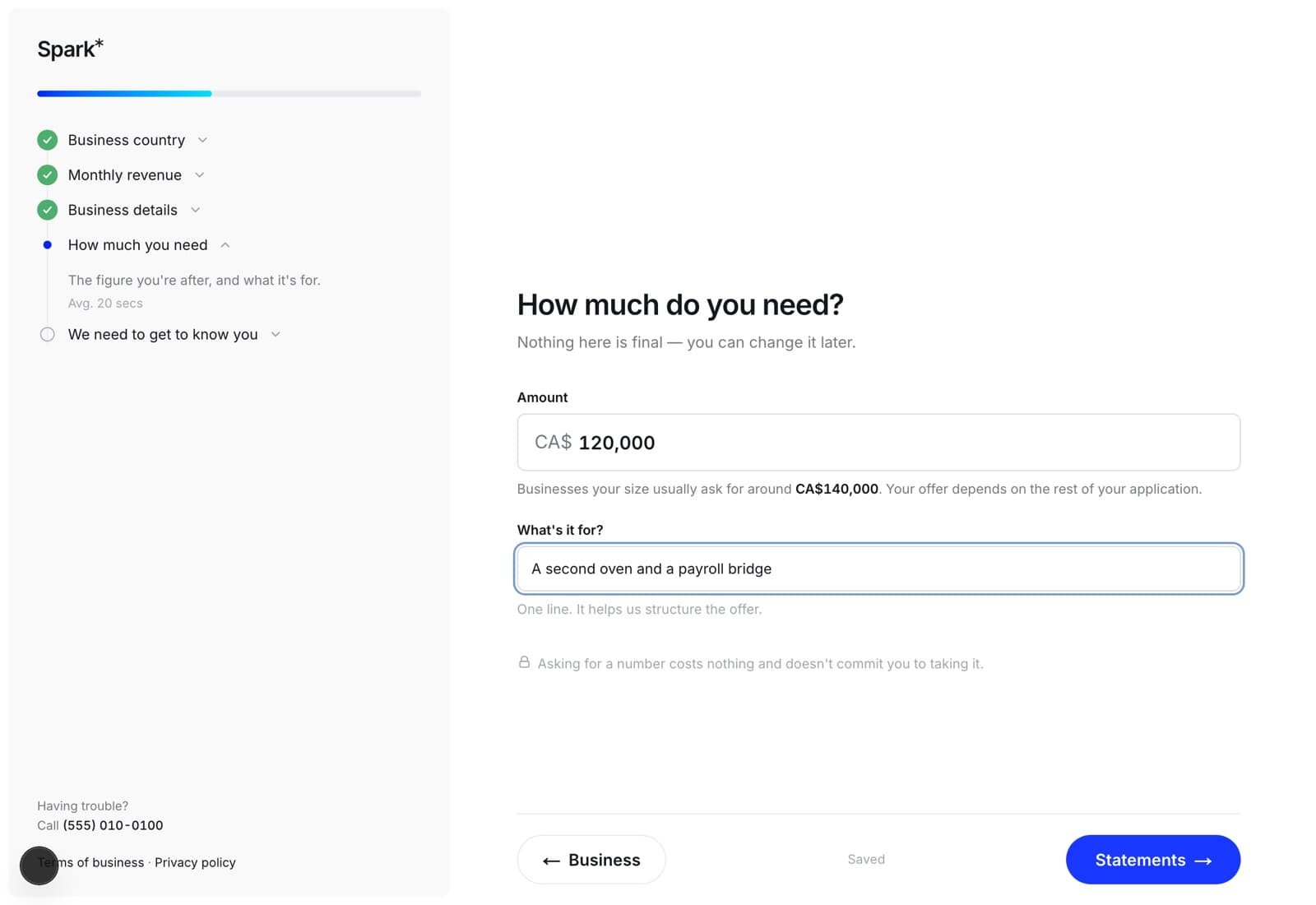
Any of these is one sentence in the box that asks what the money is for.
Said on the way in it costs you nothing. Found in the statements by somebody who then has to ask, it costs a day.
Questions
Yes. One application reaches the lenders most likely to fund it, and the mix is a question of which product fits rather than of how many applications to send.
Still deciding? Write to us. No application required.
Worth reading next
- GuideBusiness loan interest rates and what they costHow to read a funding offer by the total you repay instead of the rate, and the three numbers that decide whether it is worth taking.
- GuideWhy we ask for six months of statementsWhat an underwriter actually reads in your bank statements, and why it is usually better for you than a credit score.
Bookkeeping for auto repair: what goes where, and the GST/HST rules →