Truck financing for trucking companies
Fuel and payroll go out weekly; the invoice pays in thirty, sixty or ninety. Almost every trucking file we see is about that gap.
How the money reads
An underwriter reads six months of statements. This is what yours usually says.
- Deposits arrive per load or per settlement, so the month is lumpy.
- Fuel and driver pay leave on a weekly rhythm regardless.
- Factoring, if you use it, shows in the statements — send them anyway, it is normal and it is read as normal.
Fuel and payroll leave every week whatever the month is doing. The load pays in thirty, sixty or ninety. That distance between the two sides of the line is what nearly every haulage file is about.
The thing that slows these files down
If the receivables are already assigned to a factor, say so at the start. It does not stop a file, but a lender finding it in the statements themselves costs a day.

What it usually pays for
- A tractor, a trailer, or a reefer unit
- Covering fuel and payroll while receivables age
- Insurance and licensing when they land together
What an underwriter asks
The same four things decide every file: revenue and how long you have been making it, the cash cushion, bounced payments, and what you already pay other lenders. Here is what those look like in this trade.
- Are the invoices already factored?
- Factoring is ordinary in haulage and it does not stop a file. What a lender needs to know is whether the receivables are already assigned, because the same invoice cannot be pledged twice. Said at the start it costs nothing.
- What is already owed against the trucks?
- Most tractors carry a loan or a lease, and those payments eat into the room you have left. Two units on finance leaves less room than one at the same revenue, however the hauling is going.
- How many customers is the revenue?
- A carrier running most of its miles for one broker reads differently from the same revenue spread across five. It is a question, not a decline — answer it in a line and the exchange never happens.
- 1Revenue, and how longThe monthly average, and the years behind it
- 2The cash cushionAverage daily balance, against a month of revenue
- 3Bounced paymentsNSF and returned items over ninety days
Totalled against monthly revenue and capped at 20% — the ceiling we pre-qualify to. This is the one that binds: two advances already running leaves less room than none, however good the rest looks.
The split shown is an example, not your file. Yours is read by a person, from your own statements.
Asking for the right amount
About a month of revenue is the usual anchor. Count what settled into the account, not what you invoiced: if you factor, the statements show the advance, and that is the figure being read.
Across every trade the anchor is the same: roughly a month of revenue, and never more than the statements support. What you already pay other lenders matters as much as what you are asking for, and you need an average of at least $20,000 a month to qualify at all.
When to ask
Freight is usually soft in the first quarter and tight in the autumn. Six months ending in February show the slow half of your year; six ending in October show the fast half. Both are fine. It is worth knowing which one you are sending.
Have these ready as well
On top of the standard file — six months of statements, your incorporation documents, your CRA business number and photo ID.
- Your safety registration, if your vehicles are over the provincial weight threshold — CVOR in Ontario, the equivalent National Safety Code registration elsewhere
- Certificates of insurance for the units
- The factoring agreement, if you have one
- A bill of sale or dealer invoice for anything you are financing
What usually fits
In this order, more often than not — though the file decides, not the trade.
Equipment financing
The oven, the van, the line. Financed against the thing itself, so the payment sits against what the thing earns.
$10,000 to $1,000,000
Revenue-based line of credit
Draw what you need, pay for what you draw, and the limit moves with your revenue. For months that are uneven, not short.
Up to $500,000
Asset-based lending
Your receivables, inventory or equipment doing some work while you still hold them. Security usually prices better than an unsecured facility.
$50,000 to $2,000,000
Where these files get harder
None of these is an automatic no. They are the things that turn a one-day decision into a conversation, and all of them are better said by you than found by an underwriter.
- Trucks registered to you personally rather than to the company
- Cargo or liability insurance that has lapsed
- Bounced payments clustered in the same weeks as fuel — it reads as running on the edge, whatever the annual figure says
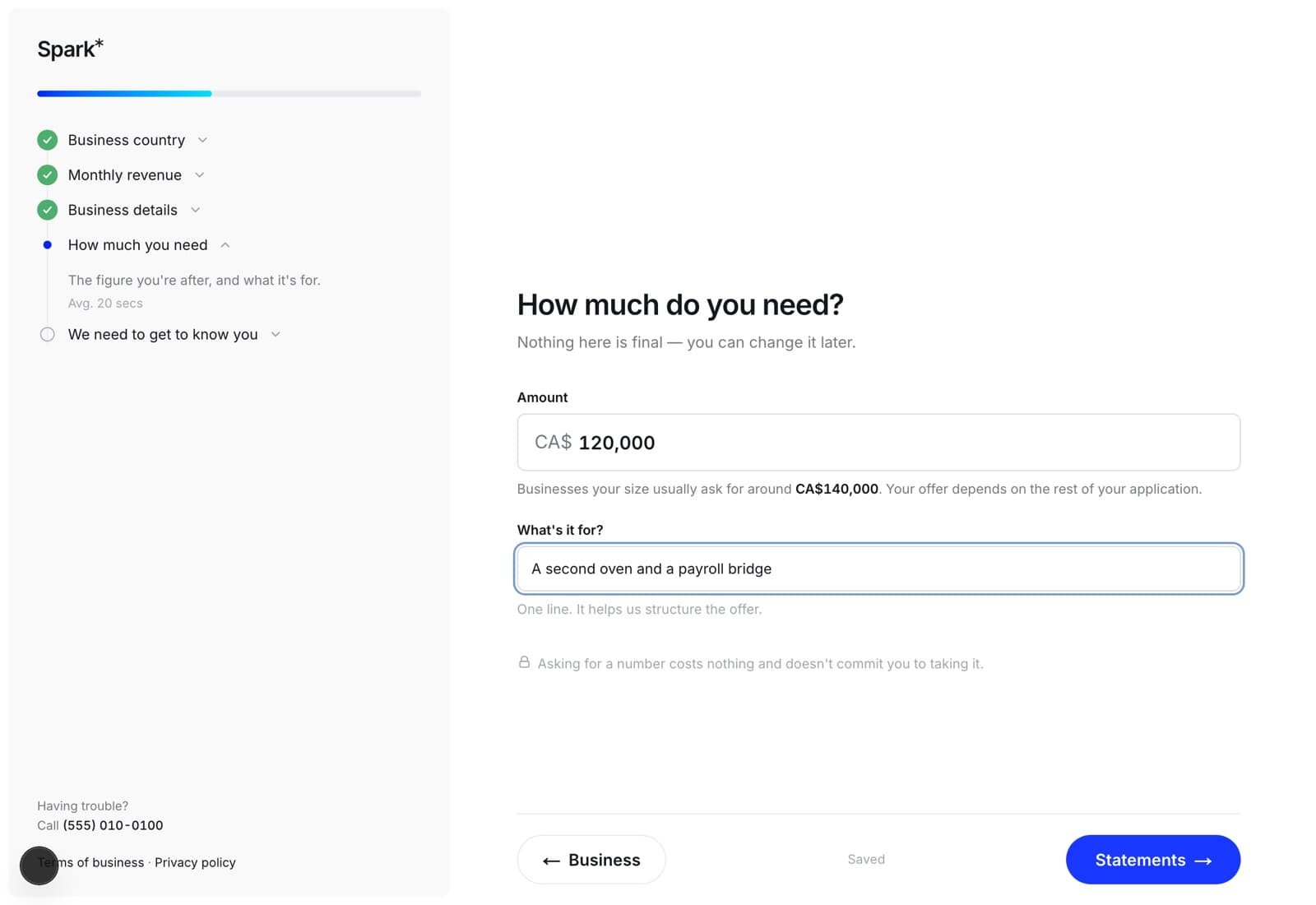
Any of these is one sentence in the box that asks what the money is for.
Said on the way in it costs you nothing. Found in the statements by somebody who then has to ask, it costs a day.
Questions
No. It is normal in this trade and it is read as normal. Mention it on the way in so a lender is not discovering it in the statements.
Still deciding? Write to us. No application required.
Worth reading next
- GuideInvoice factoring in Canada: costs and how it worksSelling your invoices for cash now, explained plainly — the advance, the fee, recourse, and when borrowing against receivables is the better deal.
- GuideWhy we ask for six months of statementsWhat an underwriter actually reads in your bank statements, and why it is usually better for you than a credit score.
Bookkeeping for trucking: what goes where, and the GST/HST rules →