Financing for cleaning companies
You pay the crew weekly and the contract pays you monthly. That gap is what most cleaning files are about.
How the money reads
An underwriter reads six months of statements. This is what yours usually says.
- Commercial contracts pay on terms; residential work pays on the day.
- Payroll is the biggest line and it never waits.
- Winning a contract shows up in the deposits about sixty days later.
The crew is paid every week and the contract pays once a month, thirty days after the work. Win a new building and that gap gets wider before it gets better.
The thing that slows these files down
Just signed something that has not started billing? Tell us. An underwriter reading the last six months cannot see the contract that changes the next six.

What it usually pays for
- Vans, floor machines, kit for a new contract
- Payroll through the ramp-up on a contract you have won
- Supplies in volume rather than by the week
What an underwriter asks
The same four things decide every file: revenue and how long you have been making it, the cash cushion, bounced payments, and what you already pay other lenders. Here is what those look like in this trade.
- How long between the work and the money?
- Commercial contracts pay on terms and the crew is paid weekly. That gap is the whole file, and the cushion — your average daily balance against a month of revenue — is what a lender reads to judge whether you can hold it open.
- What has been won but not started?
- A signed contract shows up in the deposits about sixty days later. Six months of statements cannot see it. One line naming it can.
- How concentrated is the book?
- One building is a different business from twelve. It is a question rather than a decline, and it is answered faster by you than by an underwriter guessing.
- 1Revenue, and how longThe monthly average, and the years behind it
- 2The cash cushionAverage daily balance, against a month of revenue
- 3Bounced paymentsNSF and returned items over ninety days
Totalled against monthly revenue and capped at 20% — the ceiling we pre-qualify to. This is the one that binds: two advances already running leaves less room than none, however good the rest looks.
The split shown is an example, not your file. Yours is read by a person, from your own statements.
Asking for the right amount
Size a ramp against payroll: how many weeks of crew you have to carry before the first invoice on the new contract clears. That figure is specific and it prices easily.
Across every trade the anchor is the same: roughly a month of revenue, and never more than the statements support. What you already pay other lenders matters as much as what you are asking for, and you need an average of at least $20,000 a month to qualify at all.
When to ask
Apply when the contract is signed, not when the first payroll is due. The whole point of the money is to be there before the gap opens, and a decision usually comes back within one business day.
Have these ready as well
On top of the standard file — six months of statements, your incorporation documents, your CRA business number and photo ID.
- The signed contract or purchase order for work that has not started billing
- Workers' compensation clearance and liability insurance certificates
- Quotes for vans or floor equipment you are financing
- Bonding documents, if a client requires them
What usually fits
In this order, more often than not — though the file decides, not the trade.
Revenue-based line of credit
Draw what you need, pay for what you draw, and the limit moves with your revenue. For months that are uneven, not short.
Up to $500,000
Asset-based lending
Your receivables, inventory or equipment doing some work while you still hold them. Security usually prices better than an unsecured facility.
$50,000 to $2,000,000
Equipment financing
The oven, the van, the line. Financed against the thing itself, so the payment sits against what the thing earns.
$10,000 to $1,000,000
Where these files get harder
None of these is an automatic no. They are the things that turn a one-day decision into a conversation, and all of them are better said by you than found by an underwriter.
- Payroll run in cash
- A book that is one client
- Crew paid weekly against invoices already at sixty days, with no cushion behind it
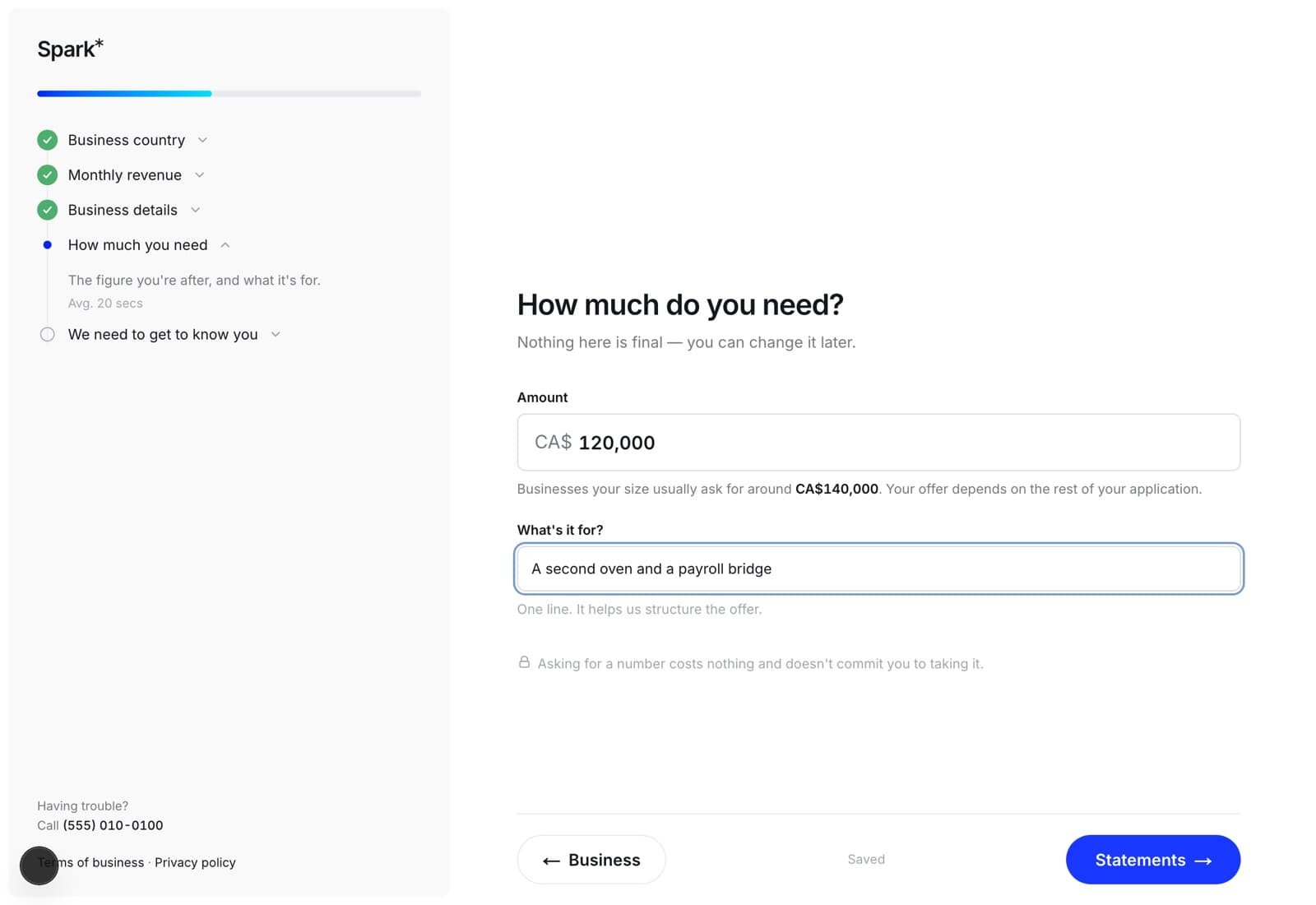
Any of these is one sentence in the box that asks what the money is for.
Said on the way in it costs you nothing. Found in the statements by somebody who then has to ask, it costs a day.
Questions
The decision is still made from the statements, but naming the contract changes how the next six months are read. Send it.
Still deciding? Write to us. No application required.
Worth reading next
- WritingAn advance or a line of credit?They solve different problems. Which one fits a one-off purchase, and which fits an uneven month.
- WritingWhat an underwriter is looking forThe eight things a person actually checks on your file, in the order they check them, and what each one is really asking.
Bookkeeping for cleaning: what goes where, and the GST/HST rules →