Giving yourself the best shot
What underwriters actually read, the four things that quietly sink a file, and how to ask for a number you will get.
5 min read
We are a brokerage: your application goes to the lenders we work with, and they decide. So the question worth answering is not "how do I impress Spark" — it is "what is the lender reading, and does my file answer it before they have to ask".
Almost all of it comes down to the bank statements.
What the numbers are read for
Before an underwriter ever sees the file, the figure we can talk to you about is worked out from a deliberately boring set of things — it is a number we have to stand behind on a phone call rather than a guess. The four that you can do something about:
- Revenue, and how long you have been making it. Both the monthly average and the years the business has been trading.
- The cash cushion. Your average daily balance measured against a month of revenue. A business that ends most days near zero has less room than one that does not, at the same revenue.
- Bounced payments. NSF and returned items over the last ninety days. None is worth something, one or two is neutral, a pattern costs.
- What you already pay lenders every month. This is the binding one. Total lender burden is capped at 20% of monthly revenue, so a business already carrying two advances pre-quals lower than an identical business carrying none, however good everything else looks.
Credit history is one of the inputs too. It carries real weight, but applying does not affect your credit; a hard pull happens only after you accept an offer. Nothing here is a scorecard decision, so whatever your credit looks like today, the file is still worth sending today.
Then the real decision is made by a person, from the statements, after you send the application. Nothing shown before that is an offer.
Four things that quietly sink a file
Sending the wrong six months. The most recent six, ending with the last full statement your bank has produced. Statements are the one thing that has to be current — it is why a repeat application carries everything else across and asks for these again.
Sending a screenshot instead of a statement. The step takes PDFs only, and it takes them for a reason: a picture of a banking app cannot be checked. Download the statement from your bank.
Leaving out an account. If the deposits land in one account and the bills leave another, send both. A file where half the money is invisible reads as a business with half the revenue.
Asking for a number with nothing behind it. The amount is not binding and you can change it, but an ask far above what the statements support means a conversation instead of an offer.
Asking for the right amount
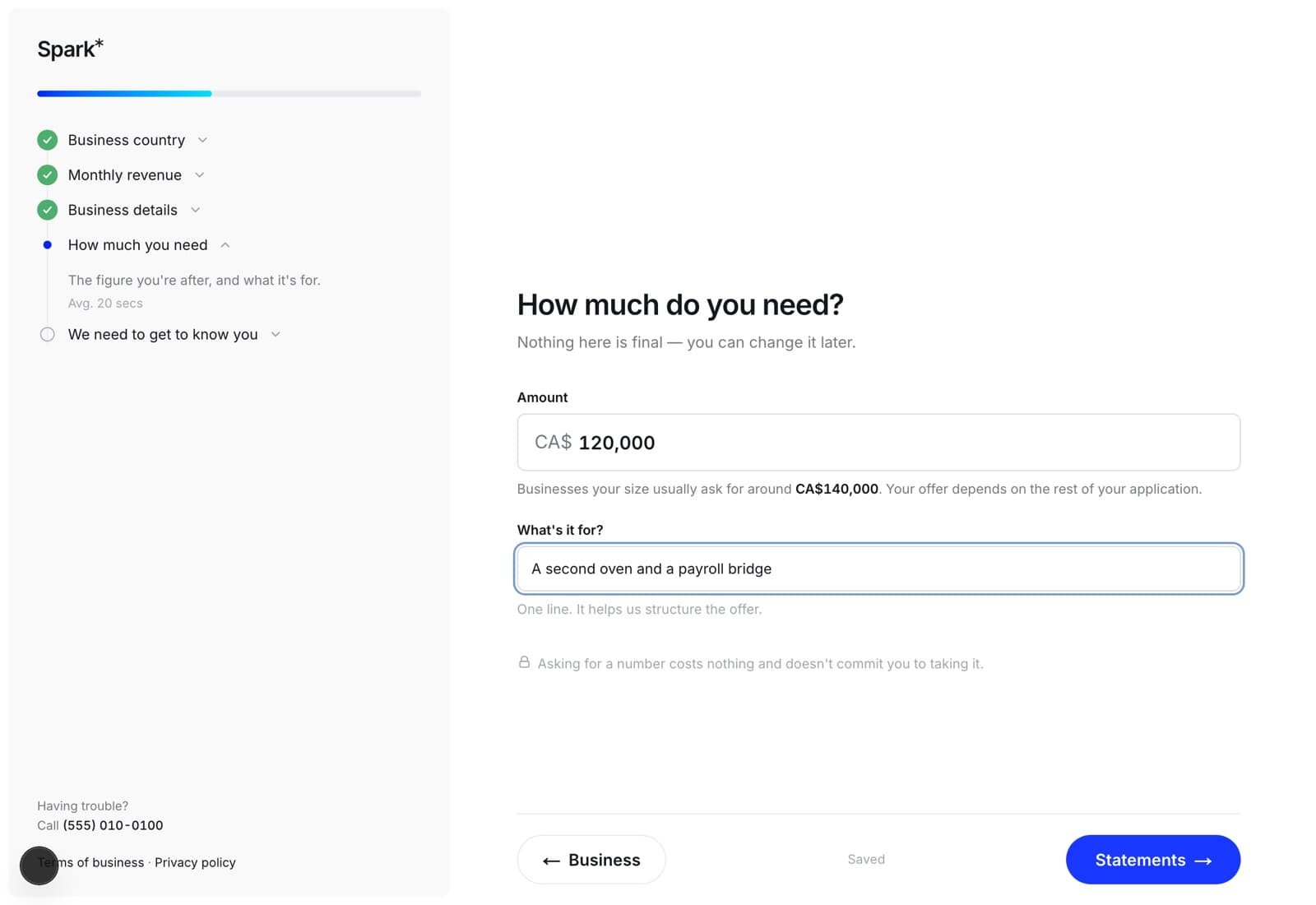
The funding step tells you what businesses of your size usually ask for. That figure is a decent anchor, and it is roughly a month of revenue.
Two more useful habits:
- Say what it is for in one line, and be concrete. "A second oven and a payroll bridge" tells an underwriter how the money turns into revenue. "Working capital" tells them nothing.
- Ask for what the thing costs. Padding an ask on the theory that you will be cut down is the fastest way to a slower decision.
Answer the obvious question before it is asked
If something in the statements needs explaining — a quiet quarter, a one-off deposit, a change of bank — say so. There is no box on the form for it: put it in the one-line "What's it for?" if it fits, and otherwise call, or reply to the email that confirms we have your application. A file that explains its own anomaly comes back faster than one that leaves an underwriter to guess, because guessing takes them a day and asking you takes two.
What does not help
- A business plan. The decision is made from the statements.
- Rushing to improve your credit first. The file is read from your statements rather than from a score, so whatever your credit looks like today, the application is worth sending today.
- Applying twice. A second application for the same business at the same time does not double your chances; it splits the attention of the person reading them.
On the web and in the app
None of this changes between surfaces — it is what the lender reads, not where you typed it.
Two practical differences worth planning around:
- Getting the statements in. At a desk they are already in a downloads folder. On a phone they have to come out of your bank's app into Files first, which is the fiddly part; do it before you open Spark. See bank statements.
- Who sends it. Only an owner can submit, on either surface. If the person assembling the file is your bookkeeper, make sure an owner is around at the end rather than discovering it at the review step. See owners and employees.